
How To Cancel Running Unit Tests In C# & .NET
[xUnit, .NET, Testing]
When testing, especially integration tests, you may find some tests that take a long time to run. Perhaps the logic is elaborate, or it depends on other, slower systems and subsystems.
You may also find that occasionally you might want to terminate a test early, for a number of reasons:
- You no longer want to wait for the test run to complete
- You know that the test is going to fail
- The dependent external systems, you know for a fact, are down.
Take, for example, this simple class.
namespace Logic;

public class ApplicationLogic
{
    public async Task<string> LongRunningOperation(CancellationToken ct)
    {
        await Task.Delay(TimeSpan.FromSeconds(30), ct);
        return "Success";
    }
}
This logic simulates a long-running operation that takes 30 seconds to run.
We then write a test for this ApplicationLogic class.
using AwesomeAssertions;
using Logic;

namespace Tests;

public class ApplicationLogicTests
{
    [Fact]
    public async Task ApplicationLogic_Returns_Expected_Result()
    {
        var sut = new ApplicationLogic();
        var result = await sut.LongRunningOperation(CancellationToken.None);
        result.Should().Be("Success");
    }
}
Here I am using xUnit3 as the test framework, and AwesomeAssertions to write assertions that are easy to read.
We can then run the test to make sure everything is ok.
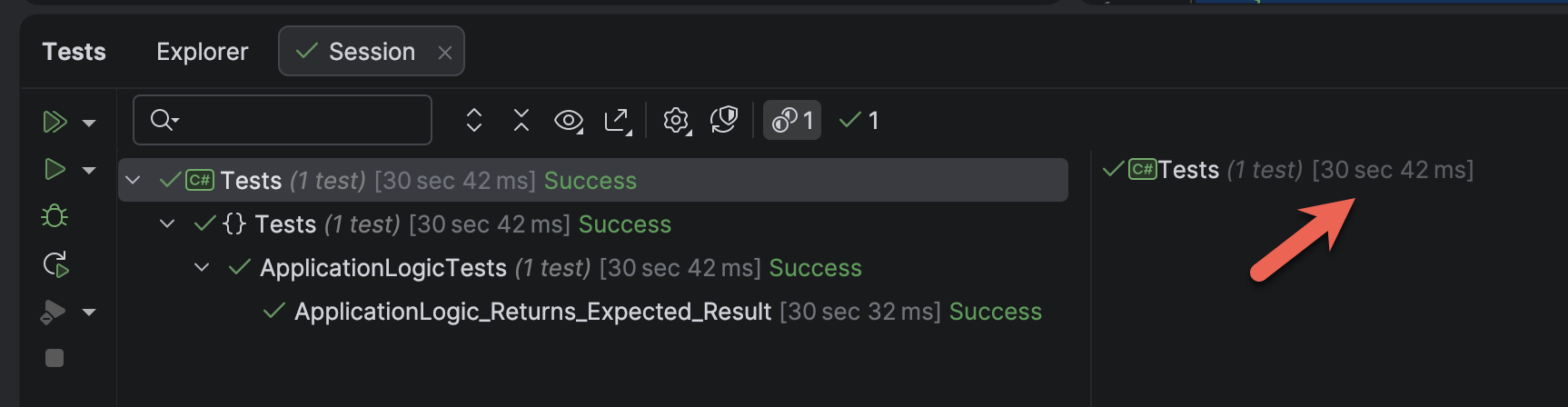
We can see here that the test successfully ran after 30 seconds.
Which is as expected.
Now, 30 seconds is a long time. Suppose we wanted to cancel a test mid-run?
The rest runner has a cancel button that looks like it should do what we expect.
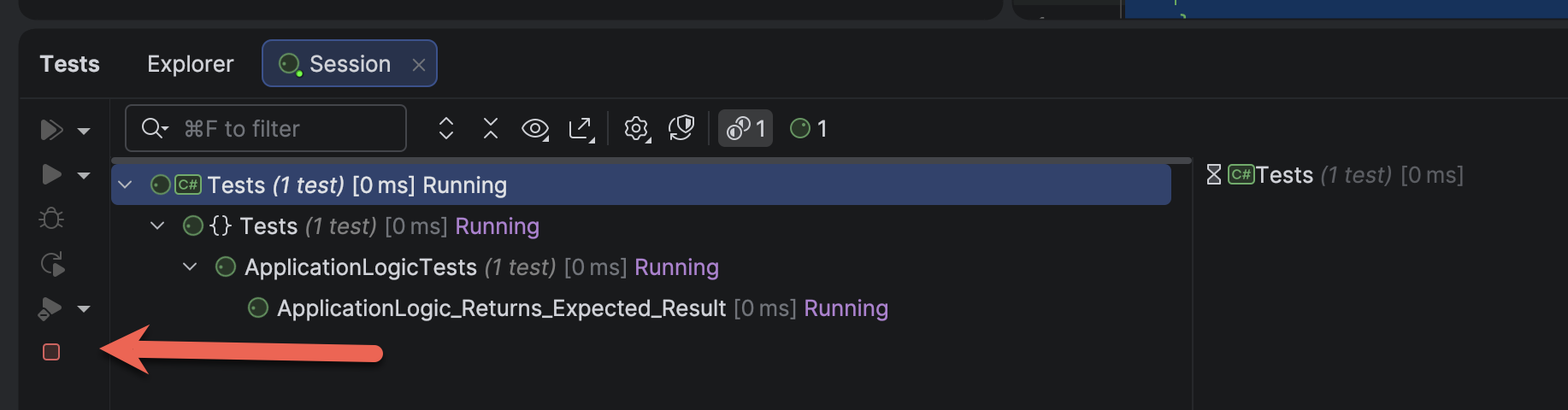
The IDE I am using is JetBrains Rider, but the same principles will apply with Visual Studio, Visual Studio Code, or any other .NET IDE that supports running tests.
You would be surprised to learn that this does not actually do anything.
The icon changes, but the test runs to completion.
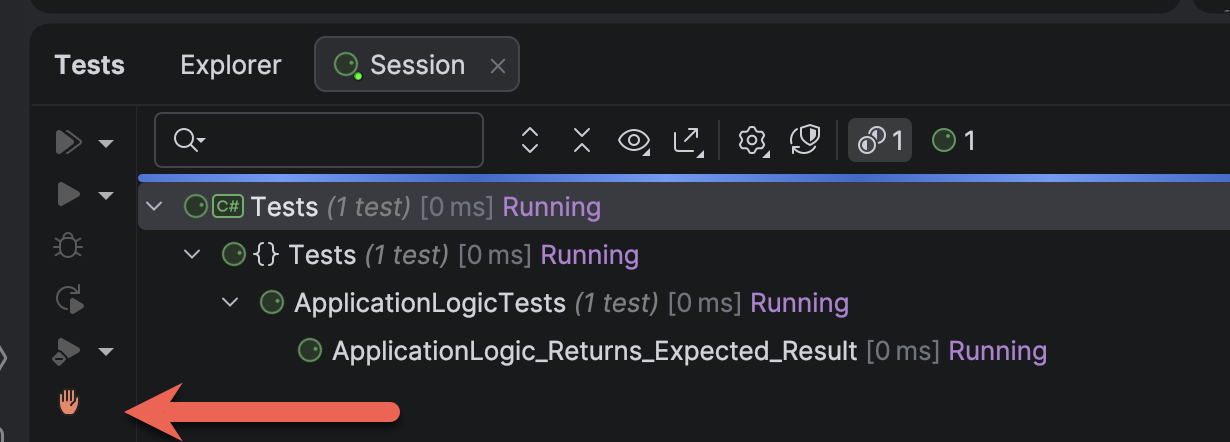
The hand icon there suggests something is happening, but no.
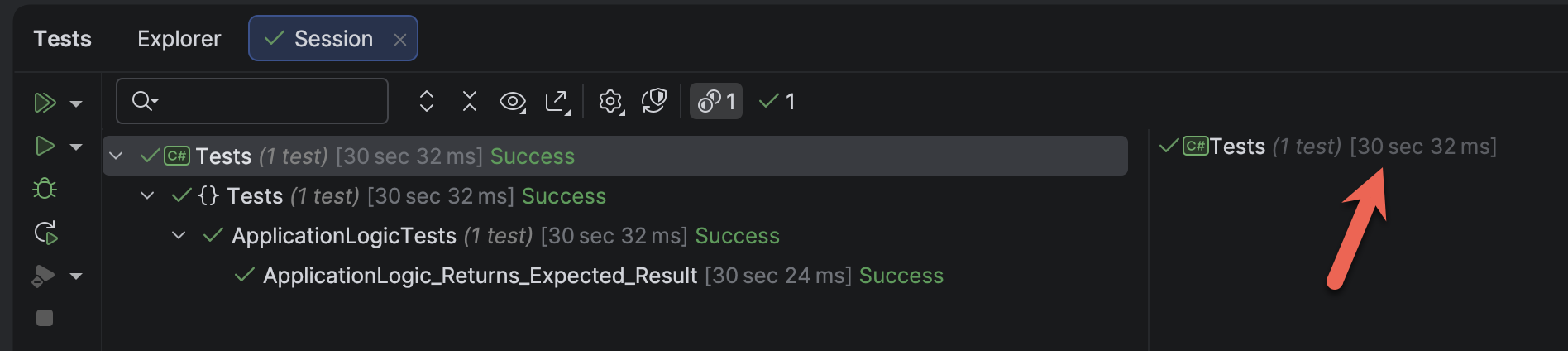
The test not only ran for the full 30 seconds, but it also reported as a success.
So how do we resolve this?
xUnit3 has two solutions to this problem.
The simplest is to use the built-in static TestContext.Current.CancellationToken that can be signalled from the test runner.
You simply change your test from this:
var sut = new ApplicationLogic();
var result = await sut.LongRunningOperation(CancellationToken.None);
result.Should().Be("Success");
To this:
var sut = new ApplicationLogic();
var result = await sut.LongRunningOperation(TestContext.Current.CancellationToken);
result.Should().Be("Success");
If we now run the test and then cancel it, it aborts immediately.

The second, and more flexible (and safer) is to inject a ITestContextAccessor into your test class, and access your CancellatonToken from there.
We do this by creating a class into which we inject the ITestContextAccessor in the constructor.
public class ApplicationLogicTestsSophisticated
{
    private readonly ITestContextAccessor _accessor;

    public ApplicationLogicTestsSophisticated(ITestContextAccessor accessor)
    {
        _accessor = accessor;
    }

    [Fact]
    public async Task ApplicationLogic_Returns_Expected_Result_With_Static_Cancel_Support()
    {
        var sut = new ApplicationLogic();
        var result = await sut.LongRunningOperation(_accessor.Current.CancellationToken);

        result.Should().Be("Success");
    }
}
This technique is safer and more testable than using the first approach.
TLDR
In xUnit3, you can write proper cancellation support for your test and test runners using either the static TestContext.Current.CancellationToken or injecting an ITestContextAccessor into your test constructor, through which you can access the CancellationToken.
The code is in my GitHub,
Happy hacking!