
How To Securely Handle Duplicate JSON Properties In C# .NET
[C#, .NET, JSON]
One of the realities of building software in the modern age is mitigating threats to the security and integrity of applications.
This is especially because most modern systems are connected via REST APIs, where data is passed around through JSON.
This is an obvious attack vector.
Take, for example, the following class:
public class Person
{
  public string Firstname { get; init; }
  public string Surname { get; init; }
}
Assume we had the following JSON produced from a REST endpoint:
{
  "Firstname": "James",
  "Surname": "Bond",
}
We would typically deserialize the JSON like so:
using System.Text.Json;
using JSONAttributes;

const string json =
    """
    {
      "Firstname": "James",
      "Surname": "Bond"
    }
    """;
var person = JsonSerializer.Deserialize<Person>(json)!;
Console.WriteLine($"Firstname: {person.Firstname}, Surname: {person.Surname}");
If we run this code, we should see the following:
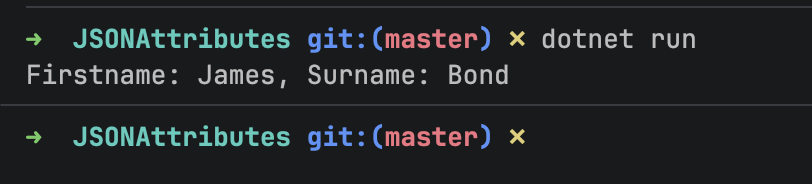
Now, suppose the JSON was in fact presented like this:
{
  "Firstname": "James",
  "Surname": "Bond",
  "Surname": "Bourne"
}
Of note here is that the Surname attribute is repeated - once with Bond, the second time with Bourne.
If we deserialized this JSON:
const string jsonAttack =
    """
    {
      "Firstname": "James",
      "Surname": "Bond",
      "Surname": "Bourne"
    }
    """;

person = JsonSerializer.Deserialize<Person>(jsonAttack)!;
Console.WriteLine($"Firstname: {person.Firstname}, Surname: {person.Surname}");
We get the following result:

We can see here that the serializer has chosen Bourne over Bond.
There is no way to know conclusively which Surname was meant.
The solution is to reject such input.
This can be accomplished using the JsonSerializerOptions class, where we set the AllowDuplicateProperties to false.
The code will look like this:
var options = new JsonSerializerOptions
{
    AllowDuplicateProperties = false
};

try
{
  person = JsonSerializer.Deserialize<Person>(jsonAttack, options)!;
  Console.WriteLine($"Firstname: {person.Firstname}, Surname: {person.Surname}");
}
catch (JsonException ex)
{
 Console.WriteLine(ex.Message);
}
If we run this code, we should see the following:

Here we can see that the serialization for the 3rd attempt failed.
TLDR
You can use the JsonSerializerOptions class, setting the AllowDuplicateProperties to false to prevent deserialization of JSON that has duplicate properties.
The code is in my GitHub.
Happy hacking!