
Writing A Generic Operating System method-level attribute for xUnit in C# & .NET
[C#, .NET, xUnit]
In a series of previous posts (“Writing A Windows-only method-level attribute for xUnit in C# & .NET”, “Writing A macOS-only method-level attribute for xUnit in C# & .NET”, and “Writing A Linux-only method-level attribute for xUnit in C# & .NET”), we looked at how to write attributes that we can decorate unit tests that we want to be run only under a particular operating system using the xUnit test framework.
The resulting solutions, LinuxOnlyFactAttribute, MacOSOnlyFactAttribute, and LinuxOnlyFactAttribute worked well for this.
However, it can be tedious having to create a new attribute for each operating system that we want to support, and there are other variants that we might want to support - for example, watchOS, tvOS, Android, etc.
A much more flexible option is to create an enum that we can pass to a generic attribute indicating the operating system we want the test to run under.
The enum would look like this:
[Flags]
public enum OSEnum
{
  Windows = 1,
  macOS = 2,
  Linux = 4,
  Android = 8,
  iOS = 16,
  tvOS = 32,
  watchOS = 64
}
Note that we are using Flags so we can combine values to specify multiple operating systems.
The attribute itself would look like this:
[AttributeUsage(AttributeTargets.Method)]
public sealed class OperatingSystemFactAttribute : FactAttribute
{
    public OperatingSystemFactAttribute(OSEnum os)
    {
        var isMatch = (os.HasFlag(OSEnum.Windows) && OperatingSystem.IsWindows()) ||
                      (os.HasFlag(OSEnum.macOS) && OperatingSystem.IsMacOS()) ||
                      (os.HasFlag(OSEnum.Android) && OperatingSystem.IsAndroid()) ||
                      (os.HasFlag(OSEnum.iOS) && OperatingSystem.IsIOS()) ||
                      (os.HasFlag(OSEnum.tvOS) && OperatingSystem.IsTvOS()) ||
                      (os.HasFlag(OSEnum.watchOS) && OperatingSystem.IsWatchOS());

        if (!isMatch)
        {
            Skip = $"{os} is supported. Current operating system does not match.";
        }
    }
}
We then decorate our tests like this:
[OperatingSystemFact(OSEnum.Windows)]
public void Config_Is_Constructed_Correctly_With_EventLog_On_Windows_Issues()
{
    var settings = ElasticSearchSettings.GetSettings(TestConstants.ConnectionString, "Innova Suiter", "1.0", true);
    var config = LoggerBuilder.GetElasticSearchLogger(settings, _output);
    config.Should().NotBeNull();
    _output.Output.Should().Contain("'Innova Suiter' is not registered as an event source");
    config.WriteTo.TestOutput(_output);
    Log.Logger = config.CreateLogger();
    Log.Information("Success");
}
If we need to specify more than one operating system, we do it like this:
[OperatingSystemFact(OSEnum.Linux | OSEnum.macOS)]
public void Config_Is_Constructed_Correctly_With_EventLog_On_Linux_And_MacOS_Issues()
{
    var settings = ElasticSearchSettings.GetSettings(TestConstants.ConnectionString, "Innova Suiter", "1.0", true);
    var config = LoggerBuilder.GetElasticSearchLogger(settings, _output);
    config.Should().NotBeNull();
    config.WriteTo.TestOutput(_output);
    Log.Logger = config.CreateLogger();
    Log.Information("Success");
}
If we run these tests on macOS:
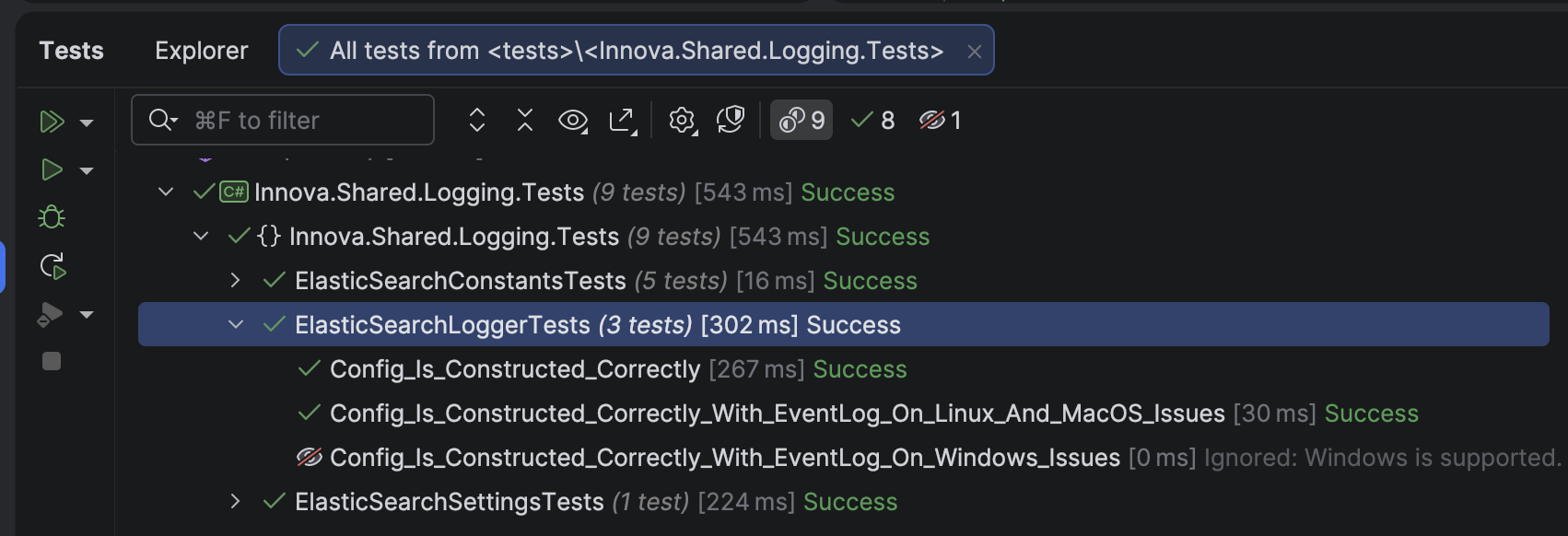
We can see here that the Windows test was skipped.
If we run the same on Windows:
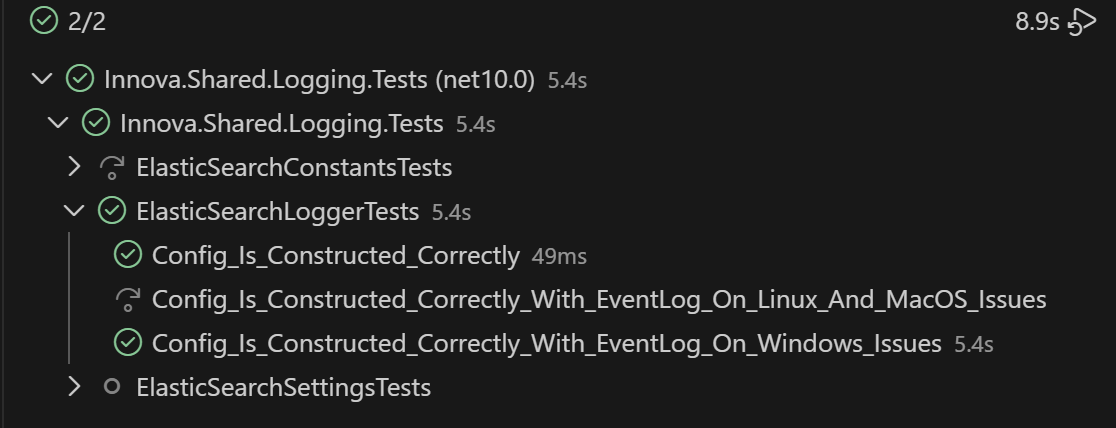
Here, we see that the Linux & macOS tests were skipped, but the Windows test was run.
TLDR
We can write a generic attribute that accepts one or more operating system enum values to indicate the supported operating systems under which the test should run.
The code is in my GitHub.
Happy hacking!