Code Housekeeping - Part 15 - Use Generic Return Types Whenever Possible
[Languages, CodeHouseKeeping, Code, Quality]
Code Housekeeping refers to general rules of thumb that make code easier to read, digest, and modify for other developers, yourself included.
In this post, we will look at the possible friction from methods that return collections.
Take the following type:
public sealed class Spy
{
  public Guid SpyID { get; set; }
  public string FullName { get; set; }
  public DateOnly DateOfBirth { get; set; }
}
Let us build a dummy repository to simulate a database.
public class Repository
{
    public List<Spy> GetSpies()
    {
        var faker = new Faker<Spy>()
            .RuleFor(s => s.SpyID, Guid.CreateVersion7())
            .RuleFor(s => s.FullName, f => f.Person.FullName)
            .RuleFor(s => s.DateOfBirth, f => DateOnly.FromDateTime(f.Date.Past(10)));
        return faker.Generate(10);
    }
}
Here I am using Bogus to generate 10 Spy entities.
Let us now write a small program to fetch the Spy entities.
var repo = new Repository();
// Get the spies
var spies = repo.GetSpies();
So far so good.
Now, let us build a second type to process these Spy objects.
public sealed class SpyProcessor
{
    public void ProcessSpies(List<Spy> spies)
    {
        foreach (Spy spy in spies)
        {
            Console.WriteLine($"Processing {spy.FullName}...");
        }
    }
}
If we look at the ProcessSpies() method, we can see that it takes a List of Spy objects.
This we can use it like this:
var repo = new Repository();
var processor = new SpyProcessor();
// Get the spies
var spies = repo.GetSpies();
// process spies
processor.ProcessSpies(spies);
This works perfectly, but the issue here is that we should not constrain our SpyProcessor out of the box to decisions made by another type.
For example, we should be able to write the SpyProcessor like this if we wanted.
namespace v2
{
    public sealed class SpyProcessor
    {
        public void ProcessSpies(Spy[] spies)
        {
            foreach (Spy spy in spies)
            {
                Console.WriteLine($"Processing {spy.FullName}...");
            }
        }
    }
}
Here, our method takes an array of Spy objects.
This breaks our program code.
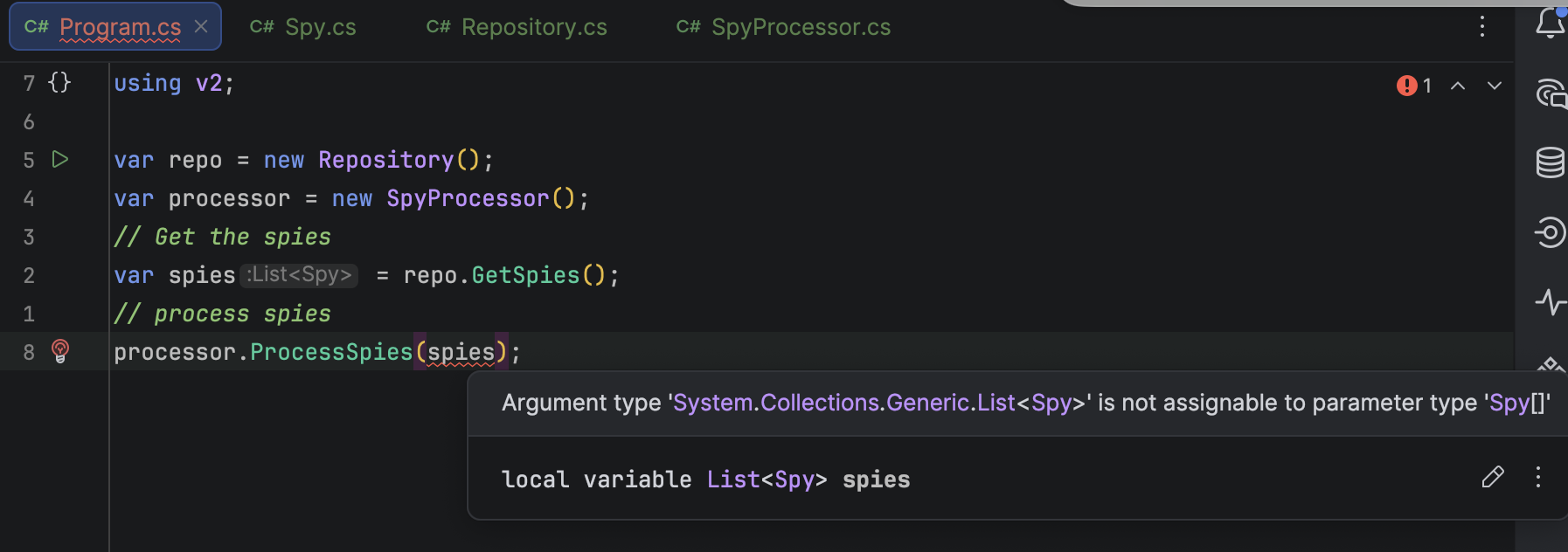
We have to resort to this to fix the issue:
processor.ProcessSpies(spies.ToArray());
Rather than do this, we can return something more generic from our Repository.
public class Repository
{
  public IEnumerable<Spy> GetSpies()
  {
    var faker = new Faker<Spy>()
      .RuleFor(s => s.SpyID, Guid.CreateVersion7())
      .RuleFor(s => s.FullName, f => f.Person.FullName)
      .RuleFor(s => s.DateOfBirth, f => DateOnly.FromDateTime(f.Date.Past(10)));
    return faker.Generate(10);
  }
}
We can then update our SpyProcessor as follows:
public sealed class SpyProcessor
{
  public void ProcessSpies(IEnumerable<Spy> spies)
  {
    foreach (Spy spy in spies)
    {
    	Console.WriteLine($"Processing {spy.FullName}...");
    }
  }
}
Our program can now revert as follows:
processor.ProcessSpies(spies);
At first glance, we have done the same thing as before - both the return and the user use the same type.
However, upon closer inspection, we have actually shifted much of the responsibility to the Repository.
Currently, much as the signature is IEnumerable of Spy, the actual raw implementation is a List of Spy.
The SpyProcessor does not know or care about this.
We are, in fact, free to change this to an array if we want.
 public IEnumerable<Spy> GetSpies()
{
    var faker = new Faker<Spy>()
        .RuleFor(s => s.SpyID, Guid.CreateVersion7())
        .RuleFor(s => s.FullName, f => f.Person.FullName)
        .RuleFor(s => s.DateOfBirth, f => DateOnly.FromDateTime(f.Date.Past(10)));
    return faker.Generate(10).ToArray();
}
The magic here is that neither our program nor the SpyProcessor needs to change to accommodate this.
Our types are thus much more shielded from downstream changes that would force us to manipulate return types using methods like ToList(), ToArray(), ToHashSet(), etc .
This is not a silver bullet, as there are times you will need the actual concrete type.
TLDR
Wherever possible, return types as generic as possible.
The code is in my GitHub.
Happy hacking!