.NET 11 Preview - Overriding Assembly Location
[C#, .NET, .NET 11 Preview]
If you wanted to get the current location of the executing Assembly, you would do it like this:
Console.WriteLine(Assembly.GetExecutingAssembly().Location);
This would return something like this:
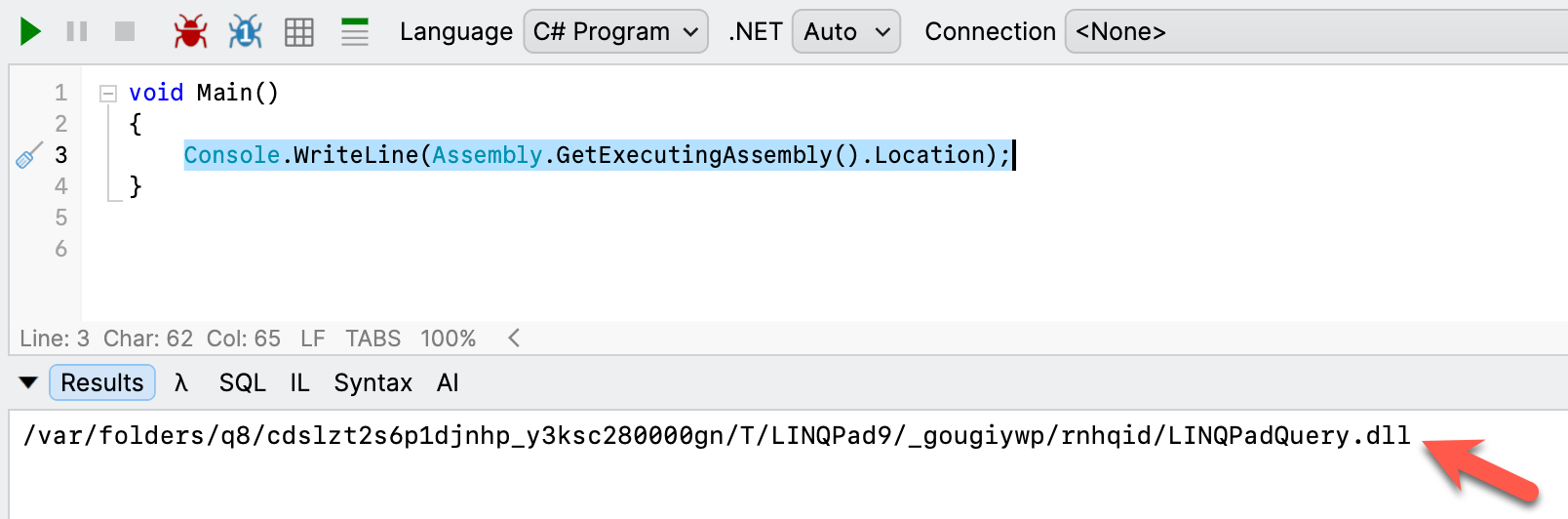
Generally, this is good enough.
However, suppose your application was modular and loaded plugins from a particular location, or, as is our case, is actually a script and not an actual application; and you wanted to get that location.
.NET 11 has an interesting solution to this problem - you can override the Assembly.Location.
You do it like this:
using System.Reflection;
using System.Runtime.Loader;
using Serilog;

Log.Logger = new LoggerConfiguration()
    .WriteTo.Console()
    .CreateLogger();

Log.Information("Default root location is {Original}", Assembly.GetExecutingAssembly().Location);

const string customDirectory = @"/User/rad/Documents/plugins/";

AssemblyLoadContext.SetAssemblyLocationOverride((assembly, defaultLocation) =>
{
    // View the default values
    Log.Warning("Original resolved location is {Original}", defaultLocation);

    // Get the assembly name
    var assemblyName = assembly.GetName().Name;

    if (assemblyName is not null)
        return Path.Combine(customDirectory, assemblyName + ".dll");
    return defaultLocation;
});

Log.Information("New resolved location is {Original}", Assembly.GetExecutingAssembly().Location);
This will print something like this:

Of interest here is:
- The location originally resolved to
/Users/rad/Projects/BlogCode/LocationRedirect/bin/Debug/net11.0/LocationRedirect.dll - It now resolves to
/User/rad/Documents/plugins/LocationRedirect.dll
The method AssemblyLoadContext.SetAssemblyLocationOverride can only be ran once in your application’s life cycle.
using System.Reflection;
using System.Runtime.Loader;
using Serilog;

Log.Logger = new LoggerConfiguration()
    .WriteTo.Console()
    .CreateLogger();

Log.Information("Default root location is {Original}", Assembly.GetExecutingAssembly().Location);

const string customDirectory = @"/User/rad/Documents/plugins/";

AssemblyLoadContext.SetAssemblyLocationOverride((assembly, defaultLocation) =>
{
    // View the default values
    Log.Warning("Original resolved location is {Original}", defaultLocation);

    // Get the assembly name
    var assemblyName = assembly.GetName().Name;

    if (assemblyName is not null)
        return Path.Combine(customDirectory, assemblyName + ".dll");
    return defaultLocation;
});

Log.Information("New resolved location is {Original}", Assembly.GetExecutingAssembly().Location);

// Change the location
AssemblyLoadContext.SetAssemblyLocationOverride((assembly, defaultLocation) =>
{
    // View the default values
    Log.Warning("Original resolved location is {Original}", defaultLocation);

    // Get the assembly name
    var assemblyName = assembly.GetName().Name;

    if (assemblyName is not null)
        return Path.Combine(customDirectory, assemblyName + "2.dll");
    return defaultLocation;
});
Here we are trying to set the location again.
If we run this code, we get the following result:

An InvalidOperationException is thrown, indicating the override has already been set.
This is to prevent abuse by silently redirecting after initial configuration.
TLDR
In .NET 11 you can now set the reported location from a call to get an Assembly location.
The code is in my GitHub.
Happy hacking!