Primary Constructors - A Practical Approach
[C#, .NET]
In a previous post, “Primary Constructors - And Their Pitfalls,” we looked at primary constructors.
Here we define our types like this:
public sealed class Spy(string Name, string Agency)
{
    public string PrintIdentification()
    {
        return $"Name: {Name}; Agency: {Agency}";
    }
}
Instead of like this:
public sealed class Spy
{
    public string Name { get; }
    public string Agency { get; }

    public Spy(string name, string agency)
    {
        Name = name;
        Agency = agency;
    }

    public string PrintIdentification()
    {
        return $"Name: {Name}; Agency: {Agency}";
    }
}
My problem with primary constructors was that the fields were mutable, and that seemed to be a huge deal breaker for me.
Since I wrote the post, I have had the opportunity to work with a number of projects and have had cause to revise my opinion.
I still think the fact that the fields are mutable is a bad thing.
However, there is a use case where I think primary constructors are usable - dependency injection scenarios. Why?
- In dependency injection, the whole point is to pass
typesaround - You fully own and control the classes wiring up and carrying out the dependency injection
Let us do a practical demonstration.
We need a custom service that sends a greeting along with the current time.
Since we want to test this, we’ll use the TimeProvider abstraction.
To support this, we need the FakeTimeProvider package.
dotnet add package Microsoft.Extensions.TimeProvider.Testing
Our CustomService will look like this:
public class CustomService(TimeProvider provider)
{
    public DateTime GetTime => provider.GetUtcNow().DateTime;
}
Here, you can see that we are using the primary constructor for the provider field.
Finally, we set up our DI.
using Microsoft.Extensions.Time.Testing;

var builder = WebApplication.CreateBuilder(args);
builder.Services.AddSingleton<TimeProvider>(new FakeTimeProvider(new DateTime(2000, 1, 1)));
builder.Services.AddSingleton<CustomService>();
var app = builder.Build();

app.MapGet("/", (CustomService service) => $"Hello World at {service.GetTime:d MMM yyyy HH:mm}");

app.Run();
Here you can see the current time is set as midnight, 1 Jan 2000.
We can then run our API and invoke the endpoint:
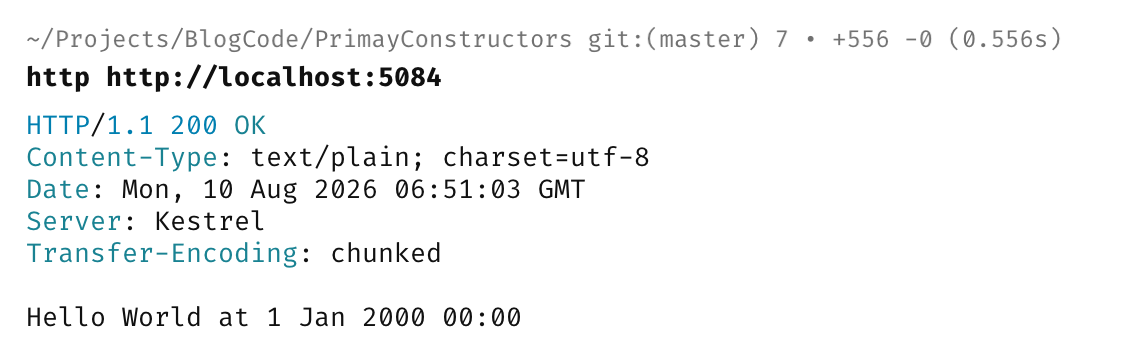
Everything works as expected.
TLDR
For internal use, such as wiring up DI, primary constructors are perfectly acceptable.
The code is in my GitHub.
Happy hacking!