
Tip - Generating GUIDs for Use in Primary Keys in SQL Server
[SQLServer, Tips, Database, SQL]
The choice of data type for primary keys is, like many other debates in the space, polarizing, with many points for and against each candidate.
But that is a discussion for another day.
Today, we are looking at a situation where you are using Microsoft SQL Server and have decided to use a Guid (UNIQUEIDENTIFIER in SQL Server Parlance).
As a reminder, the table is created as follows:
create table Animals
(
    AnimalID uniqueidentifier primary key,
    Name     nvarchar(200) not null unique
)
Insertions would be as follows:
insert into Animals(Animalid, Name)
values
(newid(), 'Dog'),
(newid(), 'Cat')
Here we are using the newid() function.
This works perfectly fine.
The problem arises when the table is busy and has many rows.
insert into Animals(Animalid, Name)
values
(newid(), 'Cat'),
(newid(), 'Dog'),
(newid(), 'Rat'),
(newid(), 'Mongoose'),
(newid(), 'Rabbit'),
(newid(), 'Skunk'),
(newid(), 'Lion'),
(newid(), 'Tiger'),
(newid(), 'Bear'),
(newid(), 'Pangolin'),
(newid(), 'Buffalo'),
(newid(), 'Rhino'),
If we query the table, the results are like so:
| AnimalID | Name |
|---|---|
| F927281D-877A-46C0-B1B4-368BC285297C | Bear |
| 0CB98455-7446-413D-933F-80B5013D98B5 | Buffalo |
| 1A842EFC-061E-46F6-9DC5-39712C3A6706 | Cat |
| 4E8625B2-B3B1-41CC-967D-471AD96D9B85 | Dog |
| 922C7DFA-E462-4709-9B84-45E564C49A80 | Lion |
| 4E4F5C6C-6BCD-4E3C-B4AD-806BAEBE4B08 | Mongoose |
| F588DA54-B7BA-4640-B259-4336DE60AD52 | Pangolin |
| 890FB3CB-7ECC-4314-AF74-7FC838082897 | Rabbit |
| 0EDBFF83-09AB-44EC-A868-00F332F670C3 | Rat |
| BFF5E234-7D1D-4D52-8596-200D06B00A92 | Rhino |
| E5CCCAC3-2FD7-4604-81C4-DFA67BB9761B | Skunk |
| D14AEC1F-FFBE-4071-B82A-DA581679E018 | Tiger |
The challenge is that, if you look at the Guids for the AnimalID, they are all over the place, given that they are, correctly and effectively, random.
This causes the following issues:
- SQL Server must keep moving data around to honor the fact that the primary key is a clustered index
- Fragmentation occurs
- There is a lot more I/O
- Inserts are therefore slower
- Over time, the queries using the primary key index get slower as well
There is a solution to this problem: the newsequentialid() function.
We can take the opportunity here to specify the primary key as database-generated and use the newsequentialid() function as the column default for the primary key.
create table Animals
(
    AnimalID uniqueidentifier primary key default (newsequentialid()),
    Name     nvarchar(200) not null unique
)
Our inserts would now look like this:
insert Animals(name)
values ('Bear'),
       ('Buffalo'),
       ('Cat'),
       ('Dog'),
       ('Lion'),
       ('Mongoose'),
       ('Pangolin'),
       ('Rabbit'),
       ('Rat'),
       ('Rhino'),
       ('Skunk'),
       ('Tiger')
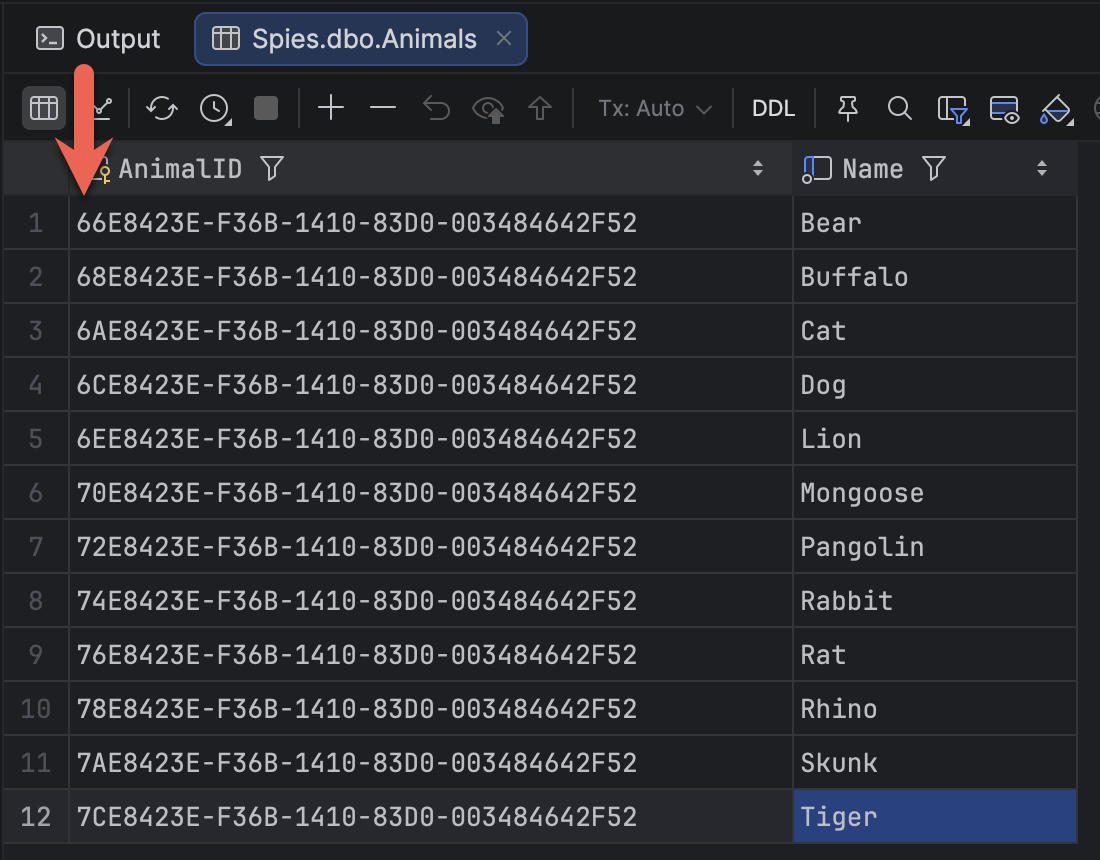
If we now query the table:
| AnimalID | Name |
|---|---|
| 66E8423E-F36B-1410-83D0-003484642F52 | Bear |
| 68E8423E-F36B-1410-83D0-003484642F52 | Buffalo |
| 6AE8423E-F36B-1410-83D0-003484642F52 | Cat |
| 6CE8423E-F36B-1410-83D0-003484642F52 | Dog |
| 6EE8423E-F36B-1410-83D0-003484642F52 | Lion |
| 70E8423E-F36B-1410-83D0-003484642F52 | Mongoose |
| 72E8423E-F36B-1410-83D0-003484642F52 | Pangolin |
| 74E8423E-F36B-1410-83D0-003484642F52 | Rabbit |
| 76E8423E-F36B-1410-83D0-003484642F52 | Rat |
| 78E8423E-F36B-1410-83D0-003484642F52 | Rhino |
| 7AE8423E-F36B-1410-83D0-003484642F52 | Skunk |
| 7CE8423E-F36B-1410-83D0-003484642F52 | Tiger |
We can see that our primary keys are now sequential.
The benefits are:
- Faster inserts
- Less fragmentation
- Faster query performance
There are, however, some issues to be aware of:
- The generated values are machine-specific
- The values are predictable, and this should be factored into the context of the key usage
- You can only use
newsequentialid()as a column default - you can’t call it directly
TLDR
Use newsequentialid() instead of newid() to generate primary key values.
Happy hacking!