UTF8 vs ASCII Encoding In C# & .NET
[C#, .NET]
In our previous post, “UTF8 vs Unicode Encoding In C# & .NET”, we looked at the difference (and the relationship) between UTF8 Encoding and Unicode Encoding.
In this post, we shall look at the relationship between ASCII and UTF8 Encoding.
Let us look at our cipher-text:
const string text = "The quick brown fox";
We can encode both using ASCII and Unicode encoding:
const string text = "The quick brown fox";

Console.WriteLine(string.Join("-", Encoding.ASCII.GetBytes(text)));
Console.WriteLine(string.Join("-", Encoding.UTF8.GetBytes(text)));
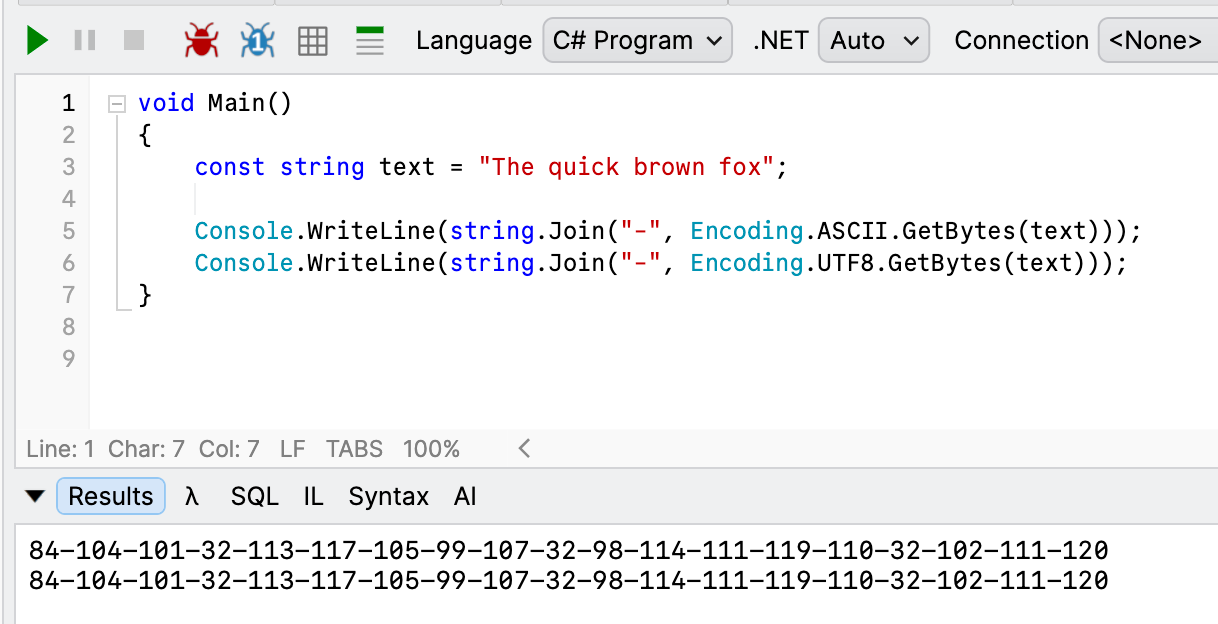
Straight away, we see the beauty behind the design of UTF8 - all ASCII encoded files are UTF8 compatible, provided the text to encode is in fact ASCII.
Should you try anything that is not ASCII, you get a problem.
Take the following:
const string text = "The quick brown fox 😂";

Console.WriteLine(string.Join("-", Encoding.ASCII.GetBytes(text)));
Console.WriteLine(string.Join("-", Encoding.UTF8.GetBytes(text)));
We can see here that there is an emoji at the end of our cipher-text.
This returns the following:
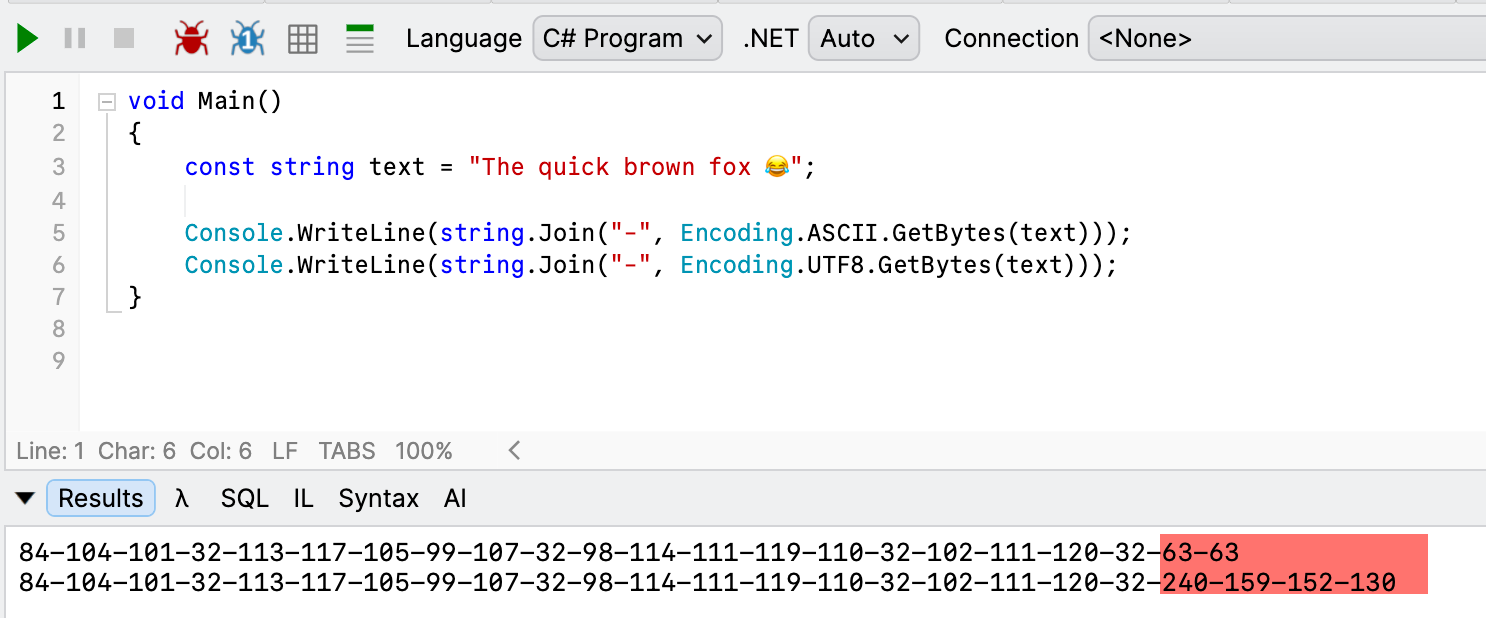
We can see here that the emoji requires 4 bytes to encode, which cannot be done in ASCII, where each character is stored in 8 bits (1 byte).
This means that any editor that can open UTF8 files can open ASCII files.
TLDR
ASCII is 100% compatible with UTF8, as any character can be encoded in ASCII encodes to the same character in UTF8.
Happy hacking!